Friday, February 23, 2024

The consolations of Februarsophy

(With apologies to Boethius) or, a Rhapsody in Bleak
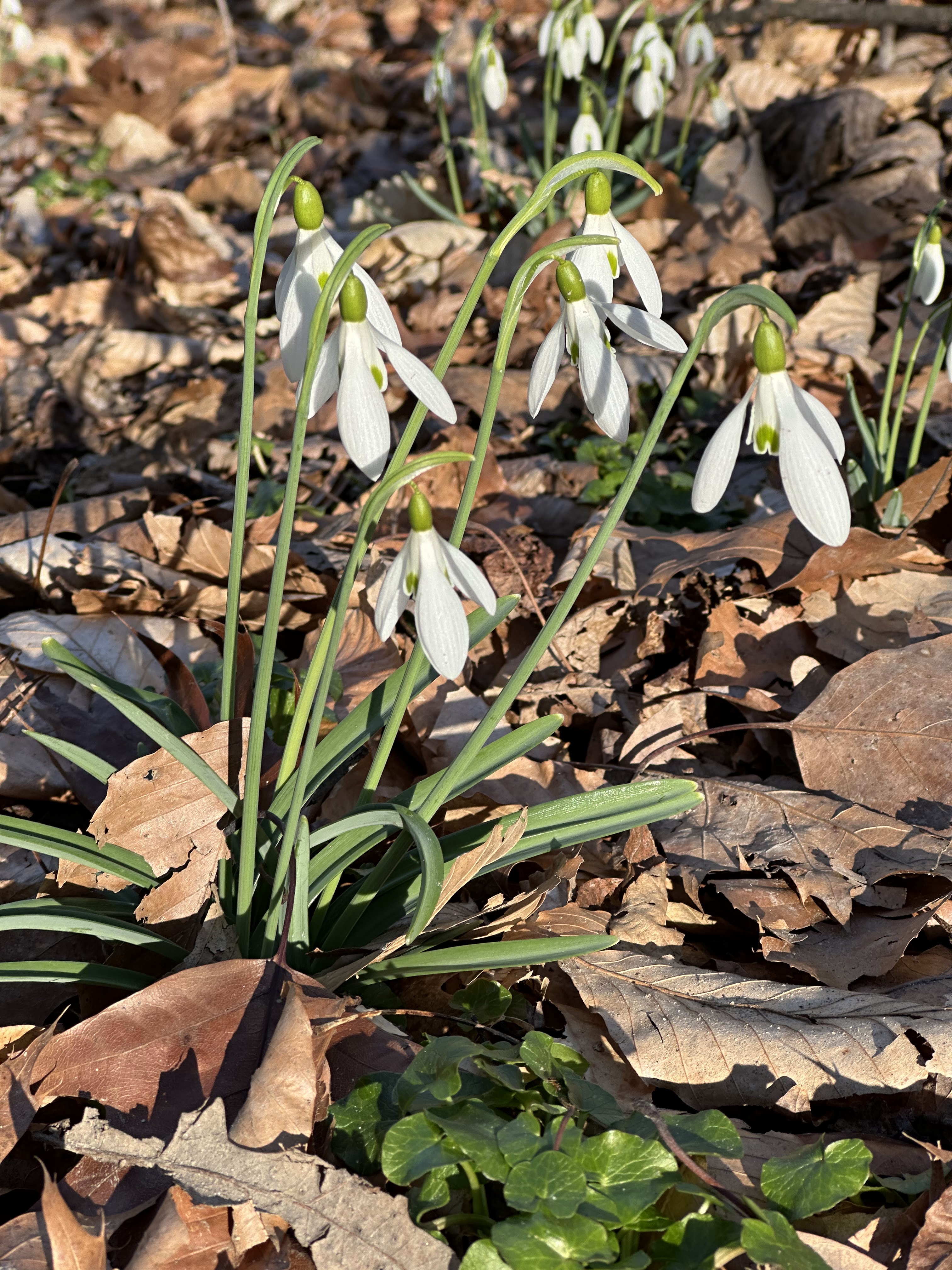

The snowdrop is a modest flower,
blooming low to ground, and casting down its gaze
.

If ever there were a month that elicits yearning for consolation, it would be February, the month that wears both crowns: shortest, chronologically; and longest, experientially.  One of my favorite comic strips yesterday had its two high-school-boy lead characters grappling with this very burden.  Is this the 39th or 46th of the month? asked Pierce; February, you’re killing me! groaned Jeremy.  

February can seem to go on forever, as we tire of winter and yearn for spring.  The days grow longer, but the cold gets stronger, a friend’s mother said.  This leap year, we have even one more day of it – though not a 39th, much less a 46th.

And yet.   There are signs throughout the bleak month that God’s mercies are not spent, and it is precisely the bleak backdrop that makes them stand out for us to observe, and marvel.  Sunrise and sunset times are not abstractions for daily Mass-goers; already now, there is light in the sky before the 6:30 Mass, and it is still bright after the 5:00 ends.  Like a freight train beginning to move, the lengthening of days began imperceptibly back in midwinter, but now picks up speed to an encouraging pace, as we added fifteen minutes of daylight at both ends of the day just in the first two week of the month.  Soon enough, it will be barreling through the equinox.

Sundry bulbs send up their shoots in response to the sun, though the chill make us disbelieve they know what they are doing.  The tug-of-war between light and cold shows by the rectory doorstep, where the hyacinths emerge crazy early, nurtured by the sun-warmed bricks on the south-facing front wall; yet the Lenten rose (hellebore), burgeoning and blooming right on time, is flattened by an overnight freeze. 

Father Novajosky rejoices to be able to begin his daily walks earlier and earlier, bundling up at first and warming as he goes.   February sun brings welcome brightness without the withering wrath of summertime; barren woods reveal their stark structure.  The still-low sun sends its now stronger light to raise sharp contrast, that even bare bark reveal its beauty.  The sunlit call of open fields and hilltop vistas is an invitation to relish and delight, not a lure to immolation for all who dare leave the protection of shade. 

Ash Wednesday this year clove the month in two; but annually and more digestibly, two great days divide it into thirds, the gift of two great men; the births of Lincoln and Washington reminding us both of what we have received as a nation, and of what we are capable.  The 12th and 22nd are still always on my mental calendar, heedless of the printed ones, as I find more fruit in remembering them than just generic “presidents.”   And speaking of the 22nd, even when Lent starts this early, the liturgical calendar gives us the Chair of Peter to celebrate, unshakeable greatness that Christ built up precisely where He was thrice denied.


Snowdrops cling to the anonymity of the crowd, springing up
not in isolated splendor, but rather huddling together
in random and irregular patches.

Yet a civic holiday is a welcome respite, too, and I took a page from Fr. Nova’s book to walk in some woods along a path I had never tried.  And mirabile vistu, there I found snowdrops, the earliest of early bloomers, before even the crocus come.  Though I hear it can be domesticated, it is most delightful in the wild, where it springs up in inexplicable and unexpected patches, just when you think all is dead and dry.  Vigorous and delicate at the same time, the snowdrops announce that even February need not be fatal, much as the start of Lent promises us of our sin.

In desolation, the tiniest gift is an abundance.  This is the wisdom, the delight, and the consolation to be found for all who have eyes to see, standing out against the bleak backdrop that is February.

Monsignor Smith

Friday, February 16, 2024

Mel Who?


You hear of him at Mass all the time, because his name in is the Roman Canon, when the priest says:  Be pleased to look upon these offerings with a serene and kindly countenance, and to accept them,as once you were pleased to accept the gifts of your servant Abel the just, the sacrifice of Abraham, our father in faith,and the offering of your high priest Melchizedek, a holy sacrifice, a spotless victim.

Maybe you recognize his name from Psalm 110, the famous “Dixit Dominus” (The Lord said to my Lord): The LORD has sworn and will not change his mind, "You are a priest for ever after the order of Melchizedek."  From the harp of David himself, this statement has such enormous significance that is expanded in the letter to the Hebrews, of which we hear a great deal during Holy Week:  We have this as a sure and steadfast anchor of the soul, a hope that enters into the inner shrine behind the curtain, where Jesus has gone as a forerunner on our behalf, having become a high priest for ever after the order of Melchizedek. (Hebrews 6:19-20)

This New Testament text points back to the story of Abraham, when among the many difficulties he encounters in following God to the fulfillment of His promise, Abram’s kinsman Lot and his family and possessions are taken by an enemy.  Abram raises a force to rescue him, and after defeating the enemy, and while returning with his kinsman and all the goods from his victory, Melchizedek king of Salem brought out bread and wine; he was priest of God Most High. And he blessed him and said, "Blessed be Abram by God Most High, maker of heaven and earth; and blessed be God Most High, who has delivered your enemies into your hand!" And Abram gave him a tenth of everything. (Genesis 14:18-20)

This is the first time in Sacred Scripture that anybody is called a priest.  He is first, by translation of his name, king of righteousness, and then he is also king of Salem, that is, king of peace. He is without father or mother or genealogy, and has neither beginning of days nor end of life, but resembling the Son of God he continues a priest for ever. See how great he is! (Hebrews 7:2-3)  Jesus is the perfect and eternal high priest; the author of Hebrews wants us to see the connection.

Saint Cyprian of Carthage stated outright what you should be discerning from these same texts when he wrote in about 250 AD:  In the priest Melchizedek we see the Sacrament of the Sacrifice of the Lord prefigured, in accord with that to which the divine Scriptures testify, where it says Melchizedek king of Salem brought out bread and wine; he was priest of God Most High. And he blessed (Abram).  That Melchizedek is in fact a type of Christ is declared in the psalms by the Holy Spirit, saying to the Son, as it were from the Father: “Before the daystar I begot you. You are a priest forever, according to the order of Melchizedek.”

Over the past few weeks, between the harangues about the Appeal, I have spoken of tithing, that is, offering to God one-tenth of everything.  That’s a word not often used in our time, or in our churches.  Where does this come from, some medieval churchman looking to fund his grandiose plans?  Some megachurch preaching a “prosperity gospel?”  Rather, it originates with Abram before he was even Abraham, in the book of Genesis of all places.  You know, “In the beginning.”  

What is the offering of your high priest Melchizedek, a holy sacrifice, a spotless victim?  Melchizedek … brought out bread and wine.  Melchizedek is the first priest, and a type and promise of the great High Priest Jesus Christ.  Abram was heavy laden with spoils from his great victory, And Abram gave him a tenth of everything.  

Monsignor Smith

Friday, February 09, 2024

Beyond basic accounting

Among the rosary chapels in the ambulatory of the Basilica,
the mosaic for the fourth Sorrowful Mystery clearly juxtaposes
Christ carrying his cross with Issac carrying the wood for his own sacrifice.

Would you rather that God tell you
 personally what you are to sacrifice this Lent?

Sacrifice.  Oblation.  Expiation.   Progressively these words are less familiar, less intelligible, less often heard.   Sacrifice; that one we might understand.  It is something you give up in order to obtain a different, better thing.   We may “sacrifice” desserts in order to obtain a slimmer figure, or “sacrifice” time at home to obtain advancement at work.   Such transactional understanding reflects our economic and commercial dispositions, describing a quid pro quo between parties that are otherwise equal, or peers.  Sacrifice, then, is the price one pays.

This price-paying takes on added significance when someone other than the one paying receives the benefit, such as the supreme sacrifice our military personnel have made for the freedom and prosperity you and I enjoy.   Sacrifice can kill you.  Yet even that undeniable sacrifice does not carry the full weight of the term that we use in the context of our actions before God.

Expanding our vision to include not only our peers and equals, but also our creator God, sacrifice is what we owe and offer to God because He is God, not because He will owe or grant us anything in return.  It is right to offer sacrifice to God as a sign of adoration and gratitude, supplication and communion. Catechism of the Catholic Church  No. 2099.   As St. Augustine observed, Every action is a true sacrifice that is done so as to cling to God in communion of holiness, and thus achieve blessedness.  This clinging to God changes us as we enter the communion of holiness; and we participate in blessedness, which equates both to happiness and to holiness.

Abram’s sacrifice of Genesis 15 illustrates this clinging to God, Who, desiring to form His own special people among all the idolatrous nations, chose Abram for its head and called him by this name, which means father of many nations.  When Abram bemoaned his childlessness, he responded to God’s instructions and brought (God) all these (a heifer three years old, a she-goat three years old, a ram three years old, a turtledove, and a young pigeon), cut them in two, and laid each half over against the other; but he did not cut the birds in two. … When the sun had gone down and it was dark, behold, a smoking fire pot and a flaming torch passed between these pieces. On that day the LORD made a covenant with Abram, saying, "To your descendants I give this land…”  

But the clinging to God is taken to its height in Genesis 22, when God commands the re-named Abraham to sacrifice his late-obtained and only son, Isaac.  When they came to the place of which God had told him, Abraham built an altar there, and laid the wood in order, and bound Isaac his son, and laid him on the altar, upon the wood. Then Abraham put forth his hand, and took the knife to slay his son.  But the angel of the LORD called to him from heaven, and said, "Abraham, Abraham!" And he said, "Here am I."  He said, "Do not lay your hand on the lad or do anything to him; for now I know that you fear God, seeing you have not withheld your son, your only son, from me." 

As explained to us in Hebrews 11, By faith Abraham obeyed when he was called to go out to a place which he was to receive as an inheritance; ... By faith Abraham, when he was tested, offered up Isaac, and he who had received the promises was ready to offer up his only son, … He considered that God was able to raise men even from the dead; hence he did receive him back, and this was a symbol. 

The sacrifice of Abraham points directly to the sacrifice of the only begotten Son of God, Jesus, which is transactional in the sense that it obtains at the expense of His own life, life and freedom for someone else (you and me).  More than that, Jesus clings to God in doing His Father’s will.  

Jesus’ offering the sacrifice specified by the Father, His obedience in offering Himself, should make us wonder, what is the sacrifice that God asks of us?   The short answer is, that very sacrifice:  nothing more nor less than the once-for-all sacrifice of Jesus on the Cross.  Will it kill us?

Do not tremble in fear.  Because we are bound into Christ’s body by Baptism, we do offer this very sacrifice when we participate and partake sacramentally in the mystery of the Holy Eucharist, the sacrifice of the Mass, both offering and receiving Jesus’ self-offering in our Communion.  This relieves us of the need to offer ourselves in bloody sacrifice, yet at the same time it bestows on us the ability and obligation to bind our own, lesser sacrifices into His one effective sacrifice.  Amidst our daily actions, we cling to God in communion of holiness.

Calling to mind Abraham and all our forebears in faith, ask yourself what would you sacrifice for the health, for the very life of your children?   How would you respond if God Himself were to ask you quite individually and specifically for some sacrifice that in appearance would cost you their lives, or your own?  Then, in the light of this awareness, reflect on what God, through His Church, actually does ask you to do during Lent.  

You need not offer God the price of your life, nor of your sins.  He has paid that bill and exceeded its cost in expiation of all your sins and mine, grave and small.  You need not redeem the lives of your children and loved ones by sacrificing to God something that you otherwise need to survive; their redemption and ours is already purchased.  But how will you, in this season set apart for the purpose, cling to God in communion of holiness, and thus achieve blessedness?  Let go your grip on whatever else you cling to, whatever lesser good, and take hold of God’s promise of mercy in faith.  Though it will not kill you, this is a true sacrifice.

Monsignor Smith

Friday, February 02, 2024

Don't miss the boat

Thar she goes

Sea travel has faded from our lives much like train travel, though both were at their times the normal way to cover great distances.
  This did not diminish the drama of boarding and sailing, with its slow-motion separation and setting out for the open unknown, and similar scenes played out on railroad platforms as well.  Automobile and air travel are the most common now, and neither offers parting travelers nor those being left behind that stage for farewells.  

Boats and ships are still around, though not used for getting from point A to point B so often anymore.  Just up I-95 from us is the Maryland Cruise Terminal, where people board ships to depart and then be returned to their starting point.  They can leave their cars in the parking lot there to await their return.  On a recent visit to Fort McHenry, as I approached I had the chance to see a cruise ship docked and boarding, then watch it set out to sea past the fort while I was touring there.  The parking lot for that cruise line was full of cars, an indication that a cruise was underway.   

Right here in Four Corners, we have a ship that most people do not notice.   The long part of a church where all the people assemble is called the nave, which is the Latin word for ship.  The universal church is referred to as the Barque of Peter, or Peter’s Boat, in yet another nautical reference that calls to mind Christ climbing into Peter’s boat to preach to the crowd on shore.  It is also reassuring to remember the Peter and all the disciples were safe during the storm when Christ was in the boat with them.  

The ship reference is not only to past moments recalled in the Gospels, but also describes a reality in our moment.  We can find safety no matter the raging tempest about us when we remain in the vessel with Christ aboard, that Peter steers, and we our need for a vessel arises because we are on a journey, from where we are to where we want to be.  The ship of the Church carries us through the perils of life and across the boundary of death into new life, and as such delivers us to our destination.  Having our lives conform to the Church and her teaching, participating in the sacraments that fill us and re-fill us with divine life, is how we remain “on board” this ship.

When we enter the passenger section of the ship of Saint Bernadette, the nave of our church building, it is a participation in the larger life of the universal Church, but it is also a journey in its own right.  More like a cruise than crossing the seas, we set out knowing we will return to the same place from which we set out, but also knowing that like all travel, this will change us.   We are borne to the presence of the Living God, and we cross the threshold of Heaven to enjoy the Communion of the Holy Trinity.  After this blissful visit comes the call “All ashore,” and we must debark once again into this valley of tears.  

Aside from a few parishioners who are driven to Mass by family members who deliver them to the door, there is not even a perfunctory farewell from those who remain ashore.  Does anybody see you set off for Mass, and then return?   Is there anything in your manner, in your words upon your return that would make them wish to travel with you?

Our parking lot provides a wealth of information, as I have recently discussed here, and the large number of cars here indicates a ship has set sail filled with travelers on Sundays as well as Holy Days that are unknown to the uninformed.  Does that arouse curiosity or interest, I wonder?  

When the rains came and lifted the ark that Noah had built to the derision of his neighbors, how long did it take for them to regret that they had failed to join him?  Our God has a history of providing the vessel that will save His people from destruction.  It is good to keep this in mind as we board our own, local rescue craft.  There will always be perils and storms, but we know in whom we have put our trust.   And even though we more commonly cover distances by airplane or automobile these days, we know that our best hope for our biggest trip is to remain in the boat.

Monsignor Smith


Friday, January 26, 2024

The Sheepgate

O'er the ramparts we watched

Even if you were here that morning, you probably did not notice.
  A couple of Sundays ago, I stood outside the 7:30 Mass to greet departing worshippers and noticed a chap handing them papers from a folder.  I walked over, and not recognizing him, introduced myself asked what he was distributing.  He handed me a political tract, clearly home-made, text on white paper.  I asked him to stop distributing it, and when he argued with me I identified myself as the (legal) property owner and asked that he leave the property.  He asked that he be allowed to wait for his ride, two people who were still in the church, and I relented.

You would think that would have been enough, but no, he kept trying, and his two friends when they emerged kept trying, to push their message.  Our exchange grew rather more pointed until they finally left.  They assumed that I was preventing their propagandizing because I disagreed with its content, but that is not so.

The people assembled here to worship God in the Holy Mass – you -- are a very attractive opportunity.  You are not only disposed to be faithful and virtuous, but you are open to what you see and hear here in a way that you cannot be, if you are prudent, once you depart.  You are attuned to the voice of God and His teaching through the Church, calling you to goodness and holiness, and surrounded by people who wish to be called, as you wish to be called, to fulfill your highest and best potential, which is to be like God.  

Because of this, you have an enormous target on your back.  Do-gooders and fundraisers all want “a piece of you.”   Who better to ask for support, personal, financial, or electoral, than you?   Your priorities are known and can be mirrored back to you; your earnestness is manifest because of your presence when so many lounge elsewhere.  You are filled with the grace of communion and your sense of solidarity with your brothers and sisters is at its peak.  You are, in a word, ripe for the picking.

Approaching you with their plea here, moreover, enhances their status, burnishing it with ecclesiastical and even Divine approbation.  You are well-disposed to whatever request you receive here, because if it’s at church, it must be okay …right?

In a word, yes: it must be okay, to be here at your church.  It must be BETTER than okay, in fact.  It’s not enough to seem charitable and worthy; no, any organization that asks for your support here has to meet the full range of ecclesiastical standards for fiscal accountability and reporting.  Anyone inviting your participation must be integrated into the Church’s moral and behavioral standards, similarly meeting requirements for safeguards and reporting (not only child protection, but definitely that).  Any advocate of any cause or initiative must be in conformity to Catholic doctrine and approved by the appropriate ecclesiastical authority.  And there may be no taint of political partisanship regarding candidate or party.  But even all that is not enough to gain access to you.

Why?  First of all, because that is not why you are here.  I know many parishes where there is a speaker every month who is raising funds or advocating involvement.  But even with programs in conformity with all of the standards above, is it really what Sunday morning Mass is for

Weekly I receive mailings offering to provide a priest who can cover Masses (while raising funds for his organization); asking to be allowed to speak at our Masses about the plight of one group or another, or the benefits of one program or another; from people who want to sell you things or ask you for donations.  I turn almost all of them away, because I am the shepherd of the flock.

You may not always notice it, but I am careful even in my own preaching and speaking to emphasize the teaching of the Lord Jesus through His Church, and put at least an audible asterisk to distinguish what is merely my own opinion.  The teaching of Christ and the saving doctrine of the Church are so beautiful, so necessary, and so true, but have such a narrow window into your world that I am loathe to crowd it with anything else, much less allow your good faith to be abused by hucksters, shysters, or opportunists.  

The people who showed up a couple of weeks ago to sway you to their views probably assumed I chased them away because of what they were proposing.   It was indeed pernicious and vile, but I chased them away because you are not on offer for anybody’s project or proposal.  You are Christ’s holy people, assembled to worship Him, and I will defend you from all abuse, even when you do not notice.  

Monsignor Smith

Friday, January 19, 2024

A Room with a View?

From not-exactly the glass-enclosed nerve center....

“Expansive view includes parking lot” is not something any realtor would advertise to make a property or home attractive.  But my second-floor sitting room with its multiple windows offers precisely that, and I want to tell you that this is a feature, not a bug.

I can keep tabs on the 6:30 Mass attendance, even when I am not the celebrant.  I can see how confessions are going, to discern whether I need to go over to the church and help.  One recent Saturday, the one with the constant and heavy rain, I was convinced that few hardy souls would come out for a sacrament that can be postponed so easily.  But no – I looked out about halfway through to see eight cars in front of the church, then to watch them leave, one by one, then be replaced by another group.  Fr. Brillis wondered how I knew how many penitents he had shriven!

I can watch the daily drama of school drop-off with its choreography of minivans, sports car, pickup trucks, and Catholic assault vehicles (CAV’s), often able to guess the level of chaos in the passenger section and distractedness in the driver’s seat.  

This week the lot was shining and empty with the snowfall that cancelled school and kept Mass-goers home.  I watched to snow removal expertise of Mark Macpeak’s landscape team deftly clear the lots and the surrounding sidewalks, more than half a day before the heavy front-end loader arrived on a flatbed truck to start clearing Blair’s lot across the street.  

Just Saturday, I saw the Holy Name guys expertly dismantle and remove our outdoor creche.  You and your kids may have enjoyed that Nativity tableau up close, from the little plaza in front of the church.  But you may not have known how many people venture onto the property from the boulevard to admire the scene of the birth of the Savior from the warmth of their cars, sitting sometimes for quite a while in, you guessed it, the parking lot.  The Sunday of Epiphany, the week before, Fr. Brillis and I drove by on our way to the annual priests’ dinner that evening.  There was a car sideways in front of the creche, and as we passed I saw I a cell phone camera held up to capture the happy scene.

In more mundane moments, I can tell which of the school administration and faculty are working late – or early; I can spot when some disabled vehicle or confused driver has rolled up our driveway looking for respite, often from the madness of the beltway.  And I notice when one of our regulars or neighbors is crossing the property at highway speed.

The view changes come spring, when the great maple trees burst into leaf and my view becomes more constricted but more arboreal; less of the parking lot, and more  park-like.  That has its pleasures as well, but not the practicality and drama that are the benefit when the trees are barren. 

They paved paradise and put up a parking lot, is the refrain Joni Mitchell wove into her environmentally-plangent ballad Big Yellow Taxi, way back when I was a kid; more recently Counting Crows seems to be responsible for the rendition that is currently heard.  It’s a catchy song, but at least in our case, nobody paved paradise.  

Daily I call down God’s blessing on whoever decided not to pave all the way from the church doors to the boulevard, but rather left grass, to which was later added trees; many, splendid trees.  Those doors open into the very forecourt of heaven itself, whose splendor and delight are better even than the paradise from which our forebears were cast out.  And that we may dare to tread these sacred precincts, outside the gates of heaven there is a place to park.  We have paved the way to paradise, and put up a parking lot!  It bears watching, a truly expansive view.

Monsignor Smith


Friday, January 12, 2024

Fast-moving water


One of the things that startled Father Brillis as he moved into the rectory last month was that the administrative offices of the parish are right here in our home, the rectory.
  That is a natural and even organic thing for older parishes, in which the growth of administrative load was met first by adding one assistant to the priest(s) who had overseen the parish, then later by the addition of more helpers, more specialized, to address the increased obligations.   First, you put one more person in the rectory, then several more.   In such places, the front office can still be identified as a parlor, the conference room, a dining room; and the meeting space, a basement.  Newer parishes have a parish life center with purpose-designed offices and conference rooms, and the priests live in a separate house, sometimes not even on the campus.  This model is what Father Brillis experienced before he came.

Here, we have the older model; our campus has A School, A Church, and A Rectory, with a few multi-purpose spaces shoehorned here or there.  This may not be ideal for privacy or even domesticity, but it does make for a seamless integration of the priestly and lay elements of the administrative team.  Maybe sometimes a seam would be nice?  The situation was exaggerated over Father’s first weeks here, because it was Christmastime, and the rectory was almost just like a home for the (staff) holiday, then returned to Grand Central Station Mode upon their return.

Many parishioners never set foot in the rectory, and never deal with any of the staff in person.  This is not abnormal by any means, but it might disguise one thing about our parish that has been evident to even these occasional, or casual, rectory visitors.   The staff is …different.

No, not that they are different from you or me (which they are, but that is okay); but rather, they are different people than were our staff six months ago.  We have had complete turnover in the administrative staff of the parish since last July first.   This was not the plan.

Last summer, we had known for a while that Ron Farias, our business manager, would be retiring, and we found out that Jackie Nguyen in our tuition office would need to phase out over the coming six months for medical reasons.   Then Jackie’s situation changed rapidly, and she had to withdraw completely.  The good news for you that know and love Jackie after her two decades of work here is that finally now (January) it looks like she will get what she needs.  Don’t stop praying for her though!

Over a few months, we brought on Jennifer King, who sits at Jackie’s desk, and Theresa Deere who will be the parish bookkeeper, but in our office only two days a week.  The division of labor and responsibility clearly needed to shift around a bit, and Carol Gangnath, our receptionist, took on added importance as continuity in addition to picking up administrative responsibilities.  

The good news is that since the start of January, Jennifer is here full time, after splitting her time and talent between us and her previous employer all last autumn.  She and Theresa are excellent and have quickly taken hold of the multi-tailed monster that is the parish’s need machine.  The hard news that rolled in right before Christmas was that the surgery that Carol needed and planned for April had been moved up to January!  Poof – she’s gone, our unique staffer with historical knowledge.  

Now, don’t blame Carol – she got an opportunity and we all wanted her to take it despite her fears for its impact on us.  And she’s been working from home to coach, assist, and advise.  And she will be back.  Not only that, but we found a spiffy stand-in, willing and able to take the heat of our front office for the duration of Carol’s absence.  Many rectory regulars have already met Susan Sumner, who not only started at very short notice, but also started during the Christmas holidays.   Over-and-above effort, that.

Father Santandreu moved out at the end of July.  Father Schrenk, who joined us in late August, moved out in early December.  Even Father Brillis, who moved into the house less than four weeks ago, now has departed for a four-week visit to home and family.  Father Novajosky, whose official responsibility is study and school, is my prop and stay.  

Anthony Dao, our parish maintenance magician, and Elena Santos, our housekeeper, are still here, thank goodness.  Norma Thomas, technically a volunteer but functionally an integral part of the office, still is here before the sun rises each day. Ted Ewanciw, the principal, and his staff; Jasmine Kuzner, the DRE, and John Henderson, our music master, all abide, and they show up frequently in the rectory; but they have their own spaces elsewhere.  So not all is flux.  Just ALMOST all.  

I have grown accustomed to having my life, and not only my work, be bound up with our dedicated staff.  Over the years, so have you.  Talk about seamless: reduced-resources, personalized, parochial over-achievement right here at your disposal, in one handy location.  Meet them, get to know them, give them a little time, and watch grace build upon nature.  Father Brillis will get used to it, too.

Monsignor Smith