Friday, July 05, 2024

The kings of the earth gathered


The Imperial months are here.  Named for the two Caesars when up to that time months not merely numbered had been dedicated only to gods, Julius and Augustus were not shy to include themselves in that company.  The calendar was not the only thing they changed forever.

Julius Caesar took power to himself at a time when the venerable but sclerotic republican government of Rome could no longer respond to the needs of the vast polity that was still growing in power and complexity.   Augustus, a favored protégé who was at best a distant cousin, emerged from the chaos that followed the assassination of his predecessor and humiliated the group that had thought it was doing the nation a great favor and returning it to more virtuous leadership.  Under this new absolute monarch, the empire would achieve its apogee in size and power, a political order that would stabilize for centuries vast swathes of the world.  Within this august and Augustan order, in one of its many conquered and assimilated petty principalities, from an obscure line of kings, Jesus was born.  The angels cried Glory.

Funny, isn’t it, how the politics of the moment can distract everybody alive from what is most important?  The trappings of current governance still distract and dismay despite the abandonment of crowns and gilded chariots, castles and courtiers.  Power itself is so shiny that it can attract and hold the attention of a population regardless of whether the persons crave it for themselves or depend upon it for survival. 

For all that Julius and Augustus did to shape lives, nations, cultures, and the world order, their greatest achievements and largest legacies are tiny and circumscribed compared to what that one distant child sleeping in a feed trough would do.  But to look at this simply as an event of history, a moment from time past, is to forget that that tiny child is still hidden from the eyes that gleam with the reflected glory of political power, and still very much at work in this world.

As sclerosis burdens and even seizes the great republic, as its vast machineries pursue projects both petty and personal; as the diminishing contents of its treasuries are flung to the clamoring crowds like gold from a passing carriage; as the order that has provided prosperity frays at the edges and is evacuated at its center; as combining tribes prop up new princes ready to rally their masses to strike at the distracted sentinels of the masters; all of this clatter, all of these symptoms fail to diagnose the  great reality that is unfolding.

In the palaces where power dwells and the towers from which the populace is directed, the truth has been cast aside as unknowable, the way abandoned for expediency and efficiency, and even life itself smothered, shredded, or snuffed as an unreasonable burden.  But though the empire be governed by darkness, the light shines undimmed in small places.

In the sultry and vacated days we enjoy, who is preoccupied by the flashing of imperial powers and the rumble of imperial aspirations?  The thunder remains distant of great battles in the east – near, mid, and far; there are reports of rival potentates posturing, thrones tottering, dynasties dissolving.  But look; July is delightfully quiet, and every Washingtonian knows nothing important ever happened in August.  

The great drama of political potencies can fascinate and alarm, but the great work of this time and all time plays out in every single soul.  The deceiver and his minions have achieved much where they are permitted and preferred, but the gentle one who achieves victory through defeat is still at work.  Resistance remains and resurges, yet the true Kingdom is close at hand, this month, even today.

Only One provides peace and alone offers safety.  The Imperial months are upon us; stay awake.

Monsignor Smith

Friday, June 28, 2024

Still streaming

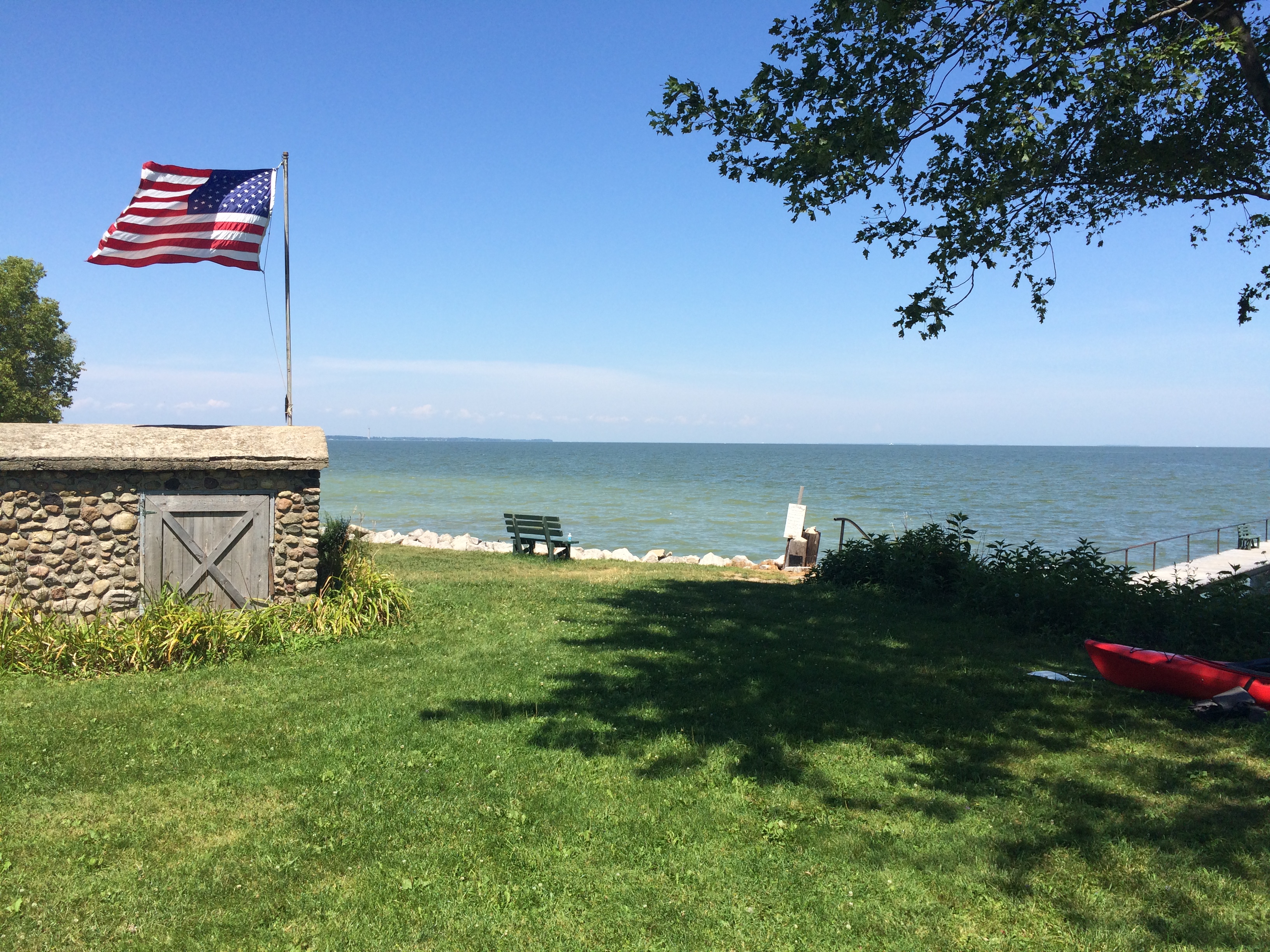
About a year before Francis Scott Key wrote about the star-spangled banner in Baltimore, Oliver Hazard Perry defeated a different British fleet at the Battle of Lake Erie, also known as the Battle of Put-in-Bay, the site of which is on the horizon beyond this streaming banner.  If you squint you can make out Perry's Monument on the island in the distance.

It was The Bicentennial.  I was in the sixth grade, and had a book about the flags of the Revolutionary War. I must have made a presentation about it in class, because the teacher had me draw a figure (like a minuteman marching by, in profile) carrying a blank flag; she copied them, and everybody in the class colored them in, adding the period flag of choice.  For some weeks, those figures marched around the top of the classroom walls like colorful crenelations.  Those varied Revolutionary flags are having something of a moment these days; I know them all well.  I’ve always liked our nation’s flags.

I was a Boy Scout, and for one season when I was in eighth grade, was a member of the color guard that raised the flag before the high school football game.  In Alabama we were serious about football.  For some decades now that team has been the Hoover High School Buccaneers, and there was a television series about them called Two-A-Days: Hoover High.   But back in 1977-78, they were the Berry High School Buccaneers, and won the state championship.  The crowds were huge, reaching ten thousand when we played hated rival Vestavia.  Four of us Scouts raised the flag during the National Anthem while the crowd silently saluted, and we took down the flag after the game with simpler solemnity.  We were serious about the flag, too.

Father Thompson, my predecessor and a Navy veteran, had a flag holder installed by the rectory door, and from May through November I put up the flag in the morning and take it down in the evening.  The other months of the year the daylight is too little and the weather too harsh for the good of the flag.  I have never accepted the new convention of leaving the flag up around the clock if there is some excuse for a light nearby.  Sometimes, I forget to take it down because I’m busy with dinner, but I always do penance for that later when I double-lock the front door.  We even bring it in if the weather gets bad. 

We have a great tall flagpole in front of the school from which a larger flag flies on schooldays.  Sometimes I notice the flag isn’t raised to the top, or the lanyard is too loose, and move to fix it myself.  I keep an eye on the condition of the flag, too, so we get a new one before it gets too ratty. 

A few years ago one of scouts installed a spiffy flagpole on the back field near the snack shack, and at the beginning of each season of munchkinball – spring baseball and fall soccer – some scouts raise the flag after I lead the munchkins in a prayer.  I am afraid they do not demonstrate much experience with the ceremony or mechanics of flag-raising to my experienced, grumpy old eyes.  And they always look at me in horror when I tell them they have to take the flag down at the end of the event, too.

Several times, the flag on the field or even the one in front of the school is left flying because somebody forgot.  I take it down as respectfully as I can and take it to the rectory, where I hold it for ransom.  I also keep the old, deteriorated flags until I can get them to our scouts, who helpfully will dispose of them correctly and respectfully.

Once, when I was retrieving a neglected flag, I laughed at myself, thinking, Who would expect me to be serious about the ordinary thing that re-presents something extraordinary and important, making tangible something so large as to be difficult to grasp?

Yes, the flag, our nation’s flag, is a sacramental, not of God or Christ or salvation, as we ordinarily use the term, but of our whole nation, history, hope, population and all.  It gives all of us and each of us an opportunity to express the respect and affection we owe our patria, our homeland that nurtures and protects us.  It is a country that is good because it is ours, as are all counties, but moreover, it is good because it is the greatest nation ever devised in its governance and guarantees of life and liberty. 

The founders, the fighters, the families that strove and established her; the leaders and the ones who served in ways martial and domestic; the conflicts recognized and resolved with mutual respect, the process that provides hope that good will prevail over preference, even of the many; all of this flutters gently in the summer breeze in a single, simple object immediately recognized over all the world for almost two and a half centuries.   We should all be serious about the flag, to nurture and express our seriousness about our nation.  

God direct and defend the United States of America!  Blessings to you this Independence Day.

Monsignor Smith


Friday, June 21, 2024

Process and personalities

Funny; it does not LOOK like a revolving door.

It is a good thing you all are good at this.
  We have another round of personnel changes here at the Holy House of Soubirous this month and it’s another one of those if-you-blink-you’ll-miss-it transitions.  

This week Father Brillis, who showed up as a surprise in December, stepped back into the mystery from which he emerged and flew to Dubai, thence perhaps to somewhere in India.   His sojourn in the United States expired, he returns to his home(s) the better for having known you.  And, just like that, there’s room at the inn.

We had already taken on another lodger.  Just after Memorial Day, Father Philip Tran of the Diocese of Beaumont (that’s in Texas, east of Houston almost in Louisiana) arrived just in time to begin the intensive summer courses for the program in Canon Law at Catholic University.  If he can stand to live with me, he says he will be back for three more summers; the intervening three academic years (six semesters, fall and spring) he will continue to take courses remotely (now everybody knows how great THAT is) while running a thriving Texas parish.  

Fr. Tran is actually from Miami, having grown up and gone to college there, and been ordained Priest for the Archdiocese of Miami.   His parents are from Vietnam.  But a few years ago he followed a priest he knew who was appointed Bishop of Beaumont, a diocese desperate for priests.  That Bishop decided to send Father Tran to CUA to study less than two weeks before the first day of class.   

Just as the quiet of Memorial Day Weekend settled over the campus here, I got a call from my old friend Father David Toups, whom some of you remember from when he was working at the USCCB.  Well, now he is Bishop David Toups of – you guessed it --  Beaumont, and he called asking if I had a room for his man.  Five days later I picked him up at the metro and moved him into the guest rooms.   

Because Canon Law comes at you fast, just like “life” does in those ads, I have plugged Fr. Tran into the Mass rotation not much at all – though he has been “Father Mystery Guest” in the confessional a couple of time.  If you have seen him, it probably was as he concelebrated one of the Sunday Masses, or the 6:30 AM weekday that is his new praxis.  He has been very low key around here, so he could put his effort into coming up to speed on school.   That ends now.

With Father Brillis gone, and Father Novajosky taking a jaunt with some of his buddies, including the lamentably departed Father Peter Santandreu, Father Tran is STEPPING UP this week to keep the fires of sanctification stoked and burning for you here in Four Corners.  Welcome him!

If you think it makes your head spin with all the changes around here, imagine what it does for mine.  Meanwhile say a prayer that God’s providence soon be revealed for the coming year, since the Archdiocese will send us nobody.  That, however, is fine; many of the best priests we have enjoyed over the past eighteen years have come to us by other ways, and The Lord’s acts of mercy are not exhausted, his compassion is not spent. (Lamentations 3:22).  Not every parish can survive this way, much less thrive this way.  It is a good thing you all are good at this.

Monsignor Smith


Friday, June 14, 2024

A guy named Joyce*


Birds of every kind shall dwell beneath it,
every winged thing in the shade of its boughs.

The marvelous ring of glory round the church where heaven comes to earth is green with leaves still fresh though no longer spring bright.  They whoosh and rustle with touchable lushness as the breezes ease these gentle days so soft and glorious it seems a shame to step inside.  Mainly maples but other trees too, our campus is pillowed with swaying green giants whose limbs extend in proffered embrace and whose whispers beg, please stay.  

This week as well is surrounded by trees.  We started the season of green Sundays with Genesis’ sad song of tree, fruit, and fall, shame and blame, the exile that endures for all.  Still green, this Sunday comes with promise of another tree, Ezekiel’s cryptic prophecy pointing to a tree planted atop a mountain by the very hand of God.   Though small, it will offer shade and shelter, rest and respite reaching unto every creature, all from the tiniest of seeds.  The cross of Christ seen from such great distance is too remote to recognize. 

Funny, isn’t it, how the work God does to rescue castaways is all organic as those markets claim to be, not mechanical, not political.  No program nor system, but seed and plant and sprout and shoot and life that grows green and new while our eyes are closed; we know not how.  Even death, death on a cross, is organic; no GMOs, you know. 

Behold how the cross of Christ stands revealed as the tree of life!   The trees on our parish lawn both protect and salute the mystery they surround.  

The trees of the two Sundays around this week and the trees around God’s house and  mine give glory to Him and joy to us.  The famous poem of these great green things was penned by a man whose infant daughter’s crippling illness brought him to the fullness of the Faith and the communion of the Church.  Both gave him solace and confidence, I hope, as he fought and died at the Battle of the Marne beneath trees stripped and shattered by the malice of men.  So here, now, Joyce Kilmer’s “Trees”

I think that I shall never see
A poem lovely as a tree. 

A tree whose hungry mouth is prest
Against the earth’s sweet flowing breast; 

A tree that looks at God all day,
And lifts her leafy arms to pray; 

A tree that may in Summer wear
A nest of robins in her hair; 

Upon whose bosom snow has lain;
Who intimately lives with rain. 

Poems are made by fools like me,
But only God can make a tree.

Last week I recalled Saint Boniface, who put his axe to a tree that men had mistaken for a god worth worshipping.   This week it seems sensible and only fair to recall it was no fault of the tree, whose beauty is a gift from God, and whose wood once held Him.

Monsignor Smith

*While you may be surprised to learn that Joyce Kilmer was a man -- with a mustache no less -- that would have been less uncommon in his own day.  The founding pastor of Saint Catherine Labouré Church over in Wheaton was Msgr. Joyce Russell.  He had retired but was still residing in the rectory when I was assigned there as a deacon for the summer of 1997.


Friday, June 07, 2024

Our hope hangs on a different tree

This week we celebrated the feast of Saint Boniface, which gave another example of how the best way to come to know all the riches and talents of the Church is to enter into her Sacred Liturgy every day, not only on Sundays and feasts.

Now, I have known Saint Boniface for a long time.  He is the patron and founder of the town of my German brother-in-law’s family, Fulda.  His tomb is in the crypt of the  cathedral there, which is built on the site where the great basilica church of the abbey he founded stood for eight centuries.  

An Englishman sent on mission to the pagans, Boniface preached to the (barbarian) German tribes and brought many of them to Christ, founding monasteries and dioceses and building up the Church and the civilization that only she can provide.  However, those successes did not satisfy him, and late in life he set out to bring Christ to the pagans of Friesland. 

Like many of their cousins across the English Channel, the Friesians worshipped trees. Saint Boniface began his conversation with them by cutting down their largest and most sacred oak.  They were not amused.  Though a number were converted, a number also attacked and killed him, cutting him down much as he cut down the tree.  

I have always thought of Saint Boniface a bit much; over the top, pushy, and at the very least, undiplomatic.  But as I re-read (for the umpteenth time) his letter in the daily Divine Office, I was reminded of several things that it is easy to forget.

First, he emphasizes that the only thing we have of value is the Faith that we have received from the Apostles who came before.  Second, he reminds us that the Church is constantly rocked by adversity and attacked by opponents for her insistence on the Truth, but that adversity and those opponents will not prevail.  Third, he points out that those who have been entrusted with the mission of pastoring souls must speak this saving truth in its entirety to those entrusted to their care, at the peril of their own souls.  I give you some of his own words:

In her voyage across the ocean of this world, the Church is like a great ship being pounded by the waves of life’s different stresses. Our duty is not to abandon ship but to keep her on her course.

The ancient fathers showed us how we should carry out this duty: Clement, Cornelius and many others in the city of Rome, Cyprian at Carthage, Athanasius at Alexandria. They all lived under emperors who were pagans; they all steered Christ’s ship—or rather his most dear spouse, the Church.  This they did by teaching and defending her, by their labors and sufferings, even to the shedding of blood.

I am terrified when I think of all this.  Fear and trembling came upon me and the darkness of my sins almost covered me. I would gladly give up the task of guiding the Church which I have accepted if I could find such an action warranted by the example of the fathers or by holy Scripture.

Let us stand fast in what is right and prepare our souls for trial. Let us wait upon God’s strengthening aid and say to him: O Lord, you have been our refuge in all generations.

Let us trust in him who has placed this burden upon us. What we ourselves cannot bear let us bear with the help of Christ. For he is all-powerful and he tells us: My yoke is easy and my burden is light.

Let us be neither dogs that do not bark, nor silent onlookers, nor paid servants who run away before the wolf.  Instead let us be careful shepherds watching over Christ’s flock.  Let us preach the whole of God’s plan to the powerful and to the humble, to rich and to poor, to men of every rank and age, as far as God gives us the strength, in season and out of season, as Saint Gregory writes in his book of Pastoral Instruction.


Thank you, Saint Boniface.  Now, hand me an axe for that stupid tree!

Monsignor Smith

Friday, May 31, 2024

Burning with love for you


June is the Month of the Sacred Heart.  This year the Solemnity falls on Friday, the seventh, and along with the next day’s Memorial of the Immaculate Heart of Mary, it marks the end of the annual liturgical feasts that move because they are calculated from the Sunday of the Resurrection of the Lord, that is, from Easter.  That’s the original meaning of the phrase “movable feast.”   Move as however it might, the Feast of the Sacred Heart always falls in June. 

June is the Month of the Sacred Heart.  You will notice our Mary Altar of May (Mary’s month is May, the month of mothers) is now occupied by our small Sacred Heart statue; our large one is over the main doors of the church, visible as you leave.  

June is the month of the Sacred Heart; it is a time for us to reflect on the reality of God’s love for us in Christ, and the nature and requirements of that love that He has commanded us to emulate, and made it possible for us to emulate.  Love one another as I have loved you.  

It is good to be Catholic, to have the divine reality arrayed across the calendar in ways that make it possible for us to understand, to remember, and to celebrate all that God is and does.  Other people associate certain months with other things, none of them as true and beautiful as life in Christ.  

Mark this month by exploring the Sacred Heart of Jesus, by entering into the mystery of God’s love enfleshed and inflamed.  Below are two prayers that have helped me grow in my devotion to the Sacred Heart.  From His pierced Heart flow blood and water that give life to the world, the font and wellspring of the Church’s sacraments.  Pray these prayers to explore the mystery of reparation, which characterizes our participation in the Divine and redeeming love, during June, the month of the Sacred Heart.

Monsignor Smith

Efficacious Novena to the Sacred Heart of Jesus

(said by St. Padre Pio for his intentions)

I. O my Jesus, You said “verily I say to You, ask and you shall receive, seek and you shall find, knock and it shall be opened to you”, behold I knock, I seek and I ask for the grace of…

Our Father, Hail Mary, Glory Be. Sacred Heart of Jesus, I put all trust in Thee.

II. O my Jesus, You said, “verily I say to You, whatsoever you shall ask the Father in My name, He will give to you”, behold in your name I ask the Father for the grace of…

Our Father, Hail Mary, Glory Be. Sacred Heart of Jesus, I put all trust in Thee.

III. O my Jesus, You said, “verily I say to You, heaven and earth shall pass away but My words shall not pass away,” behold I encouraged by your infallible words, now ask for the grace of…

Our Father, Hail Mary, Glory Be. Sacred Heart of Jesus, I put all trust in Thee.

O Sacred Heart of Jesus to whom one thing alone is impossible, namely, not to have compassion on the afflicted, have pity on us miserable sinners and grant us the grace which we ask of Thee through the Sorrowful and Immaculate Heart of Mary, your and our tender Mother.

Salve Regina. St. Joseph, Foster Father of Jesus, pray for us.


Prayer to the Sacred Heart of Jesus

Oh most holy Heart of Jesus,

fountain of every blessing,

I adore you, I love you,

and with a lively sorrow for my sins,

offer you this poor heart of mine.

Make me humble, patient, pure,

and wholly obedient to Your will.

Grant, good Jesus,

that I may live in You and for You.

Protect me in the midst of danger;

comfort me in my afflictions,

give me health of body, 

assistance in my temporal needs,

Your blessing in all that I do,

and the grace of a holy death.  


Friday, May 24, 2024

Undementing

The national D-Day Memorial in Bedford, Virginia

They call it Memorial Day here, but I wonder why.
  Seems a lot of folks know it has something to do with the military, but couldn’t tell, or do not remember, what differentiates it from Veteran’s Day.  The latter is all the living who serve now or have served in our nation’s armed services.  The former, the one we have this weekend, is for those who gave their lives in that service.  It seems both are worth remembering, and easy to forget.

My family has not generally been in the military, though my cousin’s son is now in the Air Force.  Rather than a lack of willingness, I think it reflects our chronological dissonance.  My grandfathers, for example, were born in 1910 and 1911.  They were too young for World War I and too old for World War II.  

By the time the draft kicked in for Vietnam, my dad was already thirty, six years married with two kids, and a doctoral student to boot.  That’s a whole century’s wars that we missed – or more accurately, missed us.  I am not complaining.  The one that was hardest to miss was in the previous century, and we know that Randolph Foster Hageman from my dad’s mom’s Ohio family served until discharged due to deafness, which had some causal root in the din at Gettysburg.  

By the time our modern days of “forever war” rolled around, my own peers and my  own generation were eligible and involved, but the numbers in uniformed service much smaller overall even as the days and years of fighting grew without ceasing.  My high-school buddy Tommy Pate had decided to enlist a year or so before the first Gulf War, and he got a trip to ‘the sandbox’ for explosive ordinance disposal, the mere thought of which made me cringe.  Tommy made it home with limbs and digits intact.  The most life-threatening thing I had to do was drive the construction zones of the reconfiguration of the I-495/I-395/I-95 “mixmaster” interchange in Virginia on my way to work overnight in support of our troops and fliers.  I slept in my own bed every day from noon to dinnertime; that hardly counts in the same category of service.

Everybody gets older, and we all know from personal acquaintance and personal experience that loss of memory brings loss of identity.  Failure to remember who did what for us and for our nation similarly deprives us of self-awareness and self-understanding.  As our nation approaches two-hundred fifty, are there signs of senile dementia, or worse, societal Alzheimer’s?

As you pause to look at the crowds around us clamoring for this or that, the rancor and recrimination that has spilled into our streets and squares, a check of memory may provide helpful context.  Remember that before that relatively small, relatively wealthy, and relatively educated group of men resolved to hang together lest they all hang separately, such a nation, and such government had never been known.   Remember it could be otherwise, and remember that it always and everywhere had been otherwise.  The memory may prompt an expectation and understanding, that relinquishing what makes ours the way it is will certainly invite the return of one of those other ways, the bad ones.  

Mixed up in our memories and movies are the real lives of real people we ourselves may not have known and may ourselves not have been related to who stepped forward freely and served willingly and at the price of their lives made our lives better, made our lives possible.  

If you cannot remember, write it down.  If you want everybody to remember, write it  in stone.  That makes it a Memorial, and this is the day for it.  Remember.

Monsignor Smith